EV Charging App
Charging Experience Should not to be gamble
00

problem
The EV charging experience is fragmented and unpredictable, with drivers lacking trustworthy information on charger compatibility, availability, and cost. This uncertainty disrupts decision-making, increases range anxiety, and reduces confidence in EV travel.
Goals
Ensure charger compatibility clarity
Help users quickly confirm whether a charging station supports their vehicle, connector type, and required power and availability.Provide reliable, real-time charging status
Enable users to see live availability, queue status, and charger health to avoid failed or wasted trips.Make charging time and cost predictable
Reduce anxiety by clearly communicating pricing, charging speed, and estimated completion time upfront.Build trust across the EV charging journey
Increase confidence by delivering consistent, transparent information before, during, and after charging.
Persona
Rajesh 32 years old lives in Bangalore, and works as a school teacher. He values routine, planning, and predictability in his day to day life. A few years ago, he switched to an electric vehicle drawn by lower running costs and a desire to make a more sustainable choice.
For daily commuting, the EV fits smoothly into his routine. But during longer or unfamiliar trips, Harish becomes more cautious. He plans charging stops in advance and double checks information, not because he doubts his car, but because he’s unsure if the charging infrastructure will support him when he needs it.
Rajesh is “Cautiously Optimistic”
He believes electric vehicles are the future. They’re quieter, cleaner, and cheaper to run.
But his confidence in EVs is stronger than his confidence in the charging ecosystem around them.
Decision under Pressure
Rajesh is on his way to an important meeting, expecting a routine drive. Halfway through, he notices his car is down to 10% battery just enough for the next few kilometers.
A charging station appears on his route, marked available, and for a moment, everything feels manageable. But that relief doesn’t last. He knows available doesn’t always mean the charger is working, and even if it is, it may not support his car’s adapter.
With no charge left to try another option, the drive stops being routine. Charging isn’t the problem anymore choosing the right station is.
Where to Stop?
Rajesh is planning a drive from Point A to Point B, knowing that charging his car will take close to 30–40 minutes. That single stop matters.
Choosing the wrong station could mean waiting longer than expected or wasting time in a place where he can’t do much else. As he looks at options along the route, the decision doesn’t feel simple.
He isn’t just choosing where to charge — he’s choosing how he’ll spend that waiting time, and whether the stop will fit into his day at all.
Waiting without Clarity
Rajesh finally reaches the charging station, expecting to plug in and move on. Instead, he sees a long line of cars waiting ahead of him.
One charger is already in use, and the other though visible isn’t working. People stand nearby, checking their phones, waiting without knowing how long it will take.
He realizes there’s no quick decision left to make. He has to wait. And waiting here doesn’t feel like a pause it feels like being stuck, with no clarity on when his turn will come.
Core Problem
EV charging becomes a source of anxiety not due to infrastructure scarcity, but due to cognitive overload and uncertainty caused by unreliable information—leaving users unable to predict time, cost, or outcome, and forcing them into passive, unproductive waiting.
Journey Mapping
Stage | Decide & Navigate | Reaches the station | Leaves |
|---|---|---|---|
Action | Searches for a charging station | “How long will this take?” “Should I wait or leave and risk running out of charge? | Starts charging and waits until enough battery is added to leave. |
Thoughts/ Feelings | Is this charger actually working?” “Am I making the right choice or wasting time? | How long will this take? Should I wait or leave and risk running out of charge? | “This is slower than expected” “I wish I knew this beforehand” |
Emotional State | Cautious, low confidence. | Anxiety, boredom, loss of time control. | Temporary relief mixed with frustration. |
Stress Level | 😕 | 😤 | 😡 |
Our Mission
Our mission is to design a seamless EV charging experience that replaces fragmentation with clarity, and uncertainty with decision ready, trustworthy information
Trust Gap Analysis
EV charging is a time sensitive experience where users must rely on system information to make real-world decisions. A Trust Gap Analysis was used to identify where this uncertainty appears and how it impacts user confidence, control, and comfort during charging.
Trust Gap Metrics
Observed Signal | What This Means for Users | Experience Direction |
|---|---|---|
65–70% users re check charger availability before arrival | Users doubt that “available” reflects reality and prepare for failure | Confidence Backed Availability: Show availability with strong confirmation cues that reduce second-guessing |
75–80% users repeatedly check live charging status | Users don’t trust the system to run without supervision | At a Glance Progress: Make charging state instantly understandable without manual refresh |
35–40% of session spent monitoring the app | Mental energy is consumed by uncertainty, making waiting feel longer | Passive Reassurance: Replace active checking with proactive status confirmation |
Only 30% users leave the vehicle unattended | Lack of trust prevents users from disengaging physically or mentally. | Continuity Assurance: Signals that charging will continue reliably even when users step away. |
55–60% users avoid stations after one bad experience | Trust breaks quickly and is hard to rebuild once lost. | Reliability Memory: Make consistent performance visible over time to rebuild confidence. |
20–25% users plan activities during charging | Uncertainty blocks meaningful use of waiting time. | Decision-Ready Moments: Help users clearly understand what happens next so they can plan. |
“As trust increases, user behavior shifts from constant verification to confident reliance this behavioral change is the primary success signal of the design”
Introducing a Trust-Led EV Charging Experience
Shift from “Will this Work” to “I know“
Designing for Commitment, Not Exploration
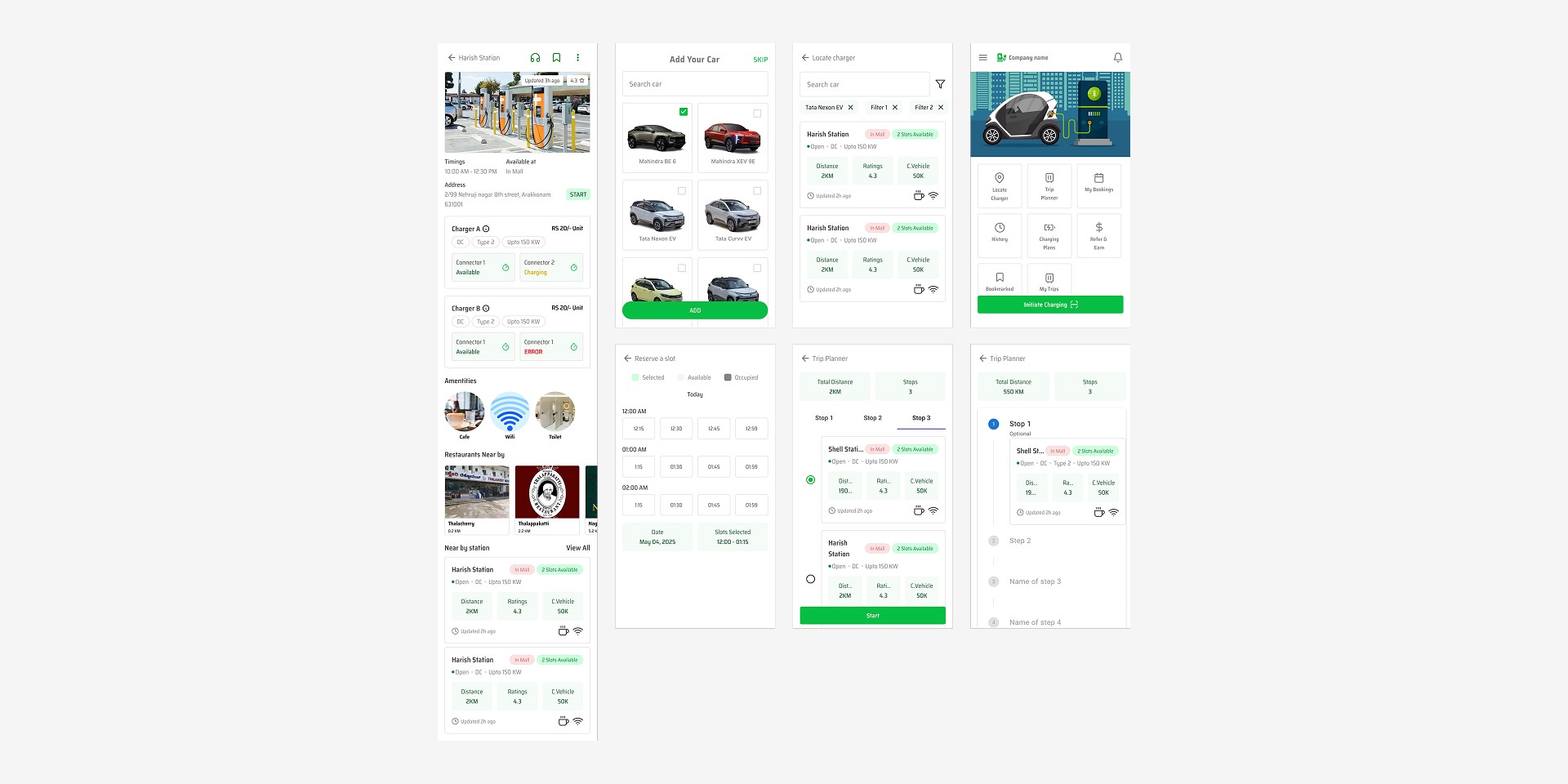
This screen helps EV drivers make a confident charging decision fast. By showing only availability, compatibility, distance, cost, and data freshness, the UI reduces uncertainty and shifts users from comparison to action at a critical moment.
Situational Confidence
This screen prioritizes real-time status and availability first, followed by price and amenities, so users can quickly assess reliability before committing. Address and nearby stations remain visible for orientation and backup, helping users stay confident even if conditions change.
Planned Confidence
This screen helps EV drivers make a confident charging decision fast. By showing only availability, compatibility, distance, cost, and data freshness, the UI reduces uncertainty and shifts users from comparison to action at a critical moment.
Scheduled Confidence
This screen lets users reserve a charging slot in advance, removing wait-time anxiety and uncertainty. By making time availability explicit, it turns charging into a planned, reliable action instead of guesswork.
After Experience
Stage | Decide & Navigate | Reaches the station | Charge & Exit |
|---|---|---|---|
Action | Selects charger based on real-time availability, updated status, and amenities | Arrives knowing a slot is reserved or available at a specific time | Charges with clear expectations and leaves when planned. |
Thoughts/ Feelings | This charger is working and available. I know what to expect | I don’t need to guess or wait. My time is under control | This went as planned. I can move on confidently |
Emotional State | Confident, reassured, in control | Calm, patient, time-aware. | Relief, satisfaction, trust in the system. |
Stress Level | 🙂 | 😌 | 😄 |
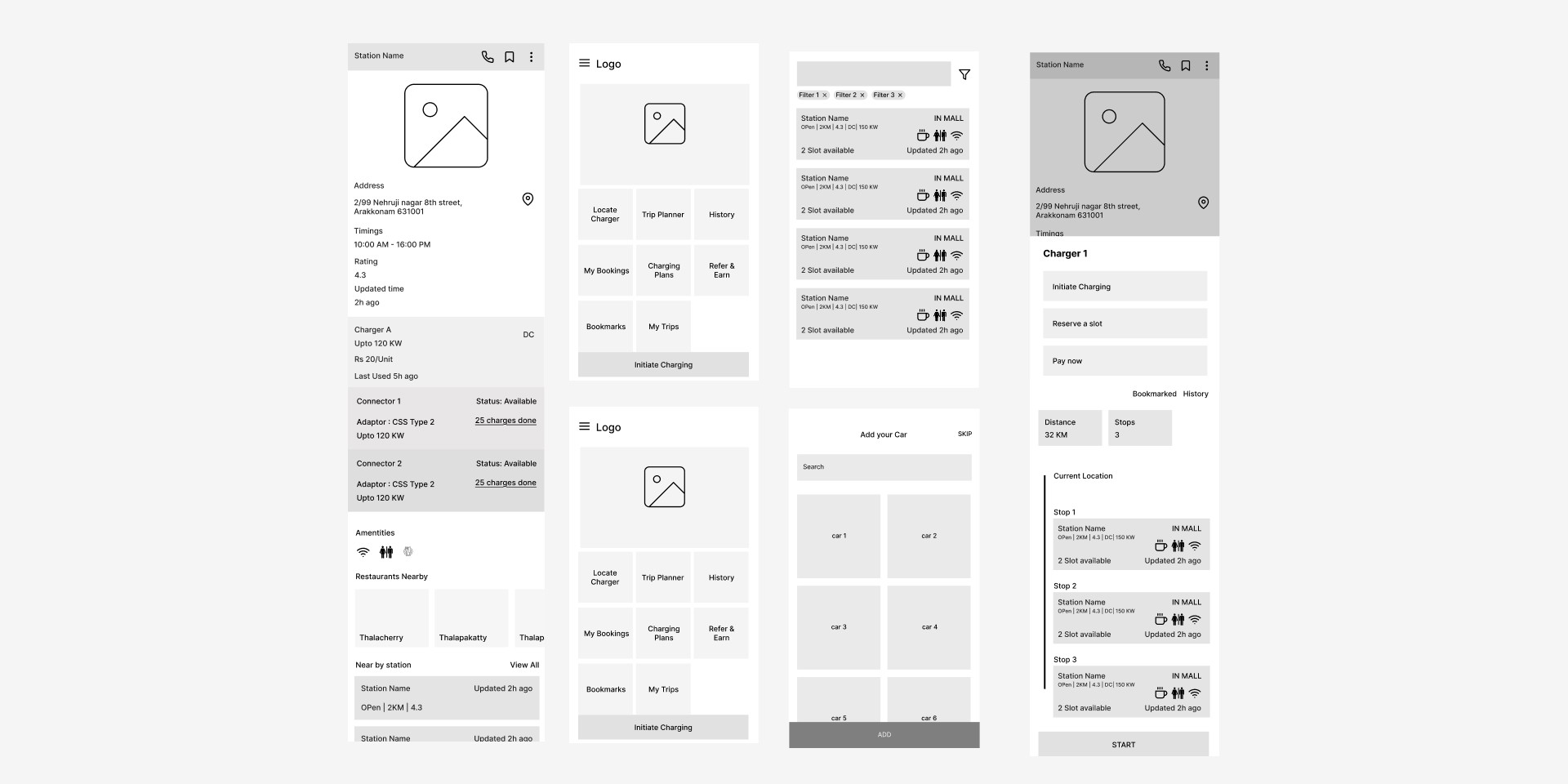
Low Fidelity Wireframe
High Fidelity Wireframe
Behavioral Impact on Decision Making
This design reduces hesitation by replacing uncertainty with clear signals of availability and timing. When users can see that a slot is available or already reserved they stop scanning for alternatives and commit sooner. The interface shifts behavior from cautious over checking to decisive action, even in high-stress, low battery situations.
Final Take Away
Design isn’t about adding features; it’s about reducing fear at the moment of decision. When uncertainty is removed, people don’t just act faster—they feel calmer, more in control, and more confident in themselves.
Thanks For Your Time
year
2025
timeframe
2 Weeks
tools
Figma, Gemini, Chat GPT, Photoshop
category
UI/UX
01

02

03

see also